Gold miners printed records. Their costs rose 22%
Warsh's Jackson Hole speech on Friday was hawkish enough to reprice September's rate hike from a 38% probability to 60.4% overnight

Gold miners printed records. Their costs rose 22%.
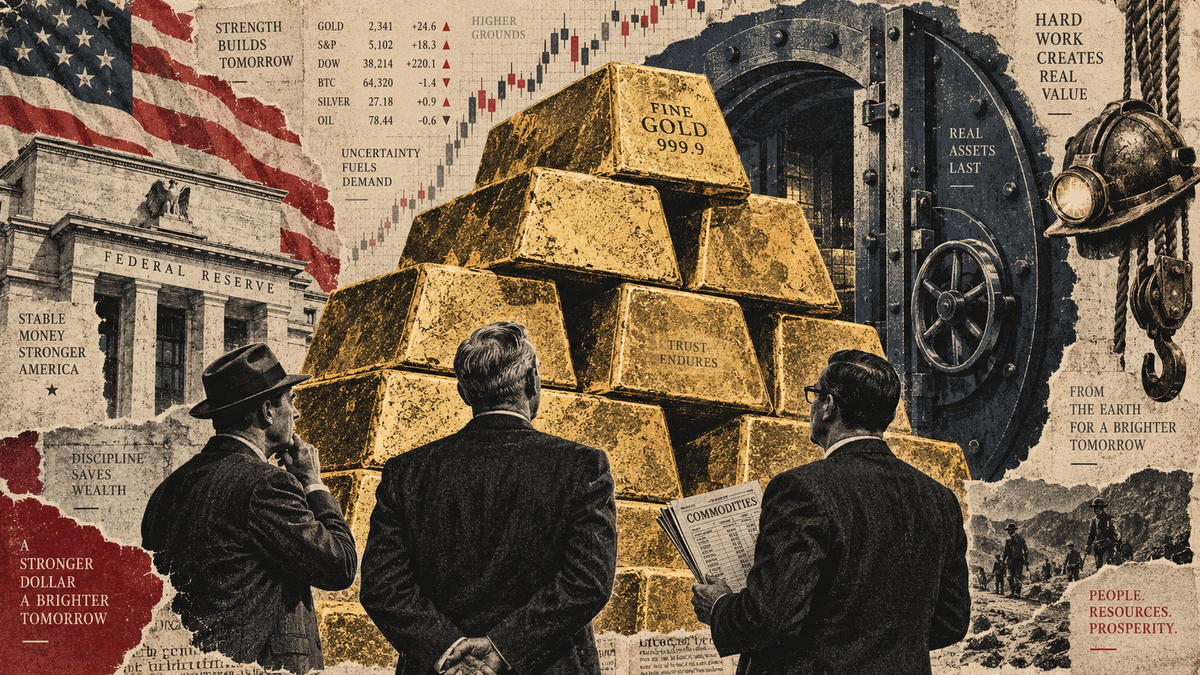
Gold near $4,500 turned into record free cash flow at every major producer. But the cost to dig an ounce out of the ground rose as much as 22% in a year — and that's the number your position now turns on.
an ounce and keep the mine running
The crimson stretch is the margin. It has not widened this year — the metal is roughly flat. The ochre stretch is what moved.
Newmont banked a record $2.2 billion of free cash in one quarter.
Producing an ounce now costs Newmont $1,938 — up about 22% in a year.
Agnico's dividend is covered more than six times by free cash flow.
Traders put 58% odds on a Fed hike that competes with your gold.
Gold sits near $4,500 an ounce. Producing one costs about $1,500.
That gap is why Newmont banked $2.2 billion of free cash in a single quarter and handed most of it straight back to you as buybacks and dividends.
But the same quarter showed something else. Costs at the big producers climbed 14% to 22% in a year.
Your hedge is working. What you need to know is what it costs to keep working.
Where the margin actually sits
Second-quarter numbers, gold averaging above $4,400.
Here's the part the headline misses: gold itself is roughly flat for 2026 after a record above $5,300 early in the year, so none of that cash came from the metal going up. It came from the gap between price and cost staying wide. Wide, not widening.
If you own GDX or a miner inside an IRA, you already own this trade.
And that distinction decides what your position does next.
What the seniors are doing
Newmont and Agnico are running the same playbook from opposite ends.
NEM produces roughly 5.3 million ounces this year plus 32 million ounces of silver, and it's putting the cash into buybacks — $6 billion authorized, $3.4 billion of net cash sitting behind it. The stock has climbed about 71% in twelve months and still trades near 12 times forward earnings, cheaper than what you'd pay for the index.
And AEM went the other way. It pays $0.45 a quarter, $1.80 a year, and that payout cost $201.6 million last quarter against $1.34 billion of free cash flow generated in the same three months. Six times over.
That matters if you're 68 and living off holdings. A dividend covered six times survives a gold price that gives back a third.
Bullion pays you nothing. Both of these pay you something.
But you're paying up for AEM at nearly 16 times forward earnings.
Where the costs are going
Now the reverse.
It costs Newmont $1,938 to produce an ounce and keep the mine running — up about 22% in a year. Kinross runs $1,821, also up 22%, against its own full-year guidance of $1,730. Agnico sits at $1,459, up 14%. Barrick told the market to expect $1,760 to $1,950 this year, against $1,637 last year.
Cost to produce an ounce What's left at $4,500 gold. Barrick is the midpoint of its own guidance range; the other three are reported second-quarter figures.
But every one is spending more per ounce than it told you it would.
Labor, electricity, royalties, thinner ore. And diesel — the same record $5.85 a gallon you paid Friday runs the haul trucks.
Then there's next Wednesday. Traders put roughly 58% odds on a Fed rate hike September 16, and a metal that pays no interest competes badly against a Treasury paying 4.7% — which is money in your pocket twice a year.
Costs rising into a possible hike. That's the bear case, stated plainly.
How this sits in a portfolio
Miners aren't gold. They're a leveraged bet on the gap between a metal price and a cost line, and both halves of that gap are moving at once.
If you spend the dividend, AEM's coverage is the argument — a payout backed six times over doesn't depend on the next print. For Band 1 holders, the buyback at NEM does more for a position built to compound.
Your hedge has a cost curve now. Watch that, not spot.
What to watch
Two dates. August CPI lands Friday, September 11 at 8:30 ET — the last inflation number before the Fed votes. The FOMC decides Wednesday, September 16 at 2:00 ET.
A hike is the direct risk to everything above, whatever your holding period. Gold pays no interest, and a higher Treasury yield is the competition. But watch the cost line too: third-quarter results land in late October, and diesel above $5.85 has been running through the haul trucks since Labor Day weekend.