ASML Just Raised Its Forecast Again. Your Semiconductor Position Matters
ASML beat Q2 estimates, raised full-year guidance 16% to €43–45B, and stock jumped 4–7% — with TSMC reporting tomorrow.

Key Points
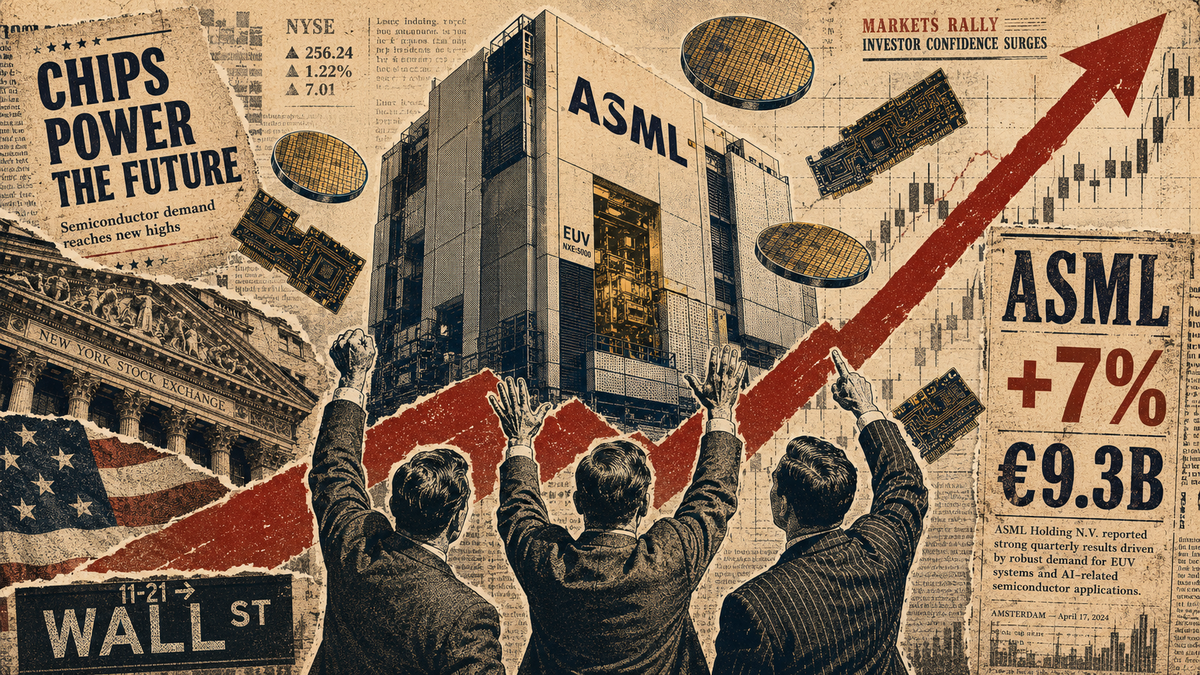
ASML raised full-year 2026 revenue guidance to €43–45B, up 16% at the midpoint from its prior forecast.Q2 net sales of €9.33B beat analyst estimates of €8.80B; net income of €2.92B topped consensus by €300M.TSMC reports Q2 2026 results Thursday July 16 — guidance calls for $39–40.2B in revenue, 30%+ full-year growth.
If you hold any broad technology ETF, any semiconductor name, or any position in NVIDIA — your portfolio has exposure to what ASML disclosed this morning.
ASML (NASDAQ: ASML) is not a household name in the way Apple or Google is. But it is the only company on the planet that manufactures extreme ultraviolet lithography machines, the equipment chipmakers must use to produce the most advanced semiconductors. No ASML machines, no advanced AI chips. The dependency runs in one direction.
This morning ASML reported Q2 results that beat its own guidance and raised its full-year outlook for the second time this year. The stock jumped 4–7% in Amsterdam before paring slightly. The number that matters most for your thinking today: full-year 2026 revenue guidance moved from €36–40B to €43–45B. That is a 16% increase at the midpoint.
Tomorrow, TSMC (NYSE: TSM) reports Q2. The two prints together tell you something specific about where the AI infrastructure cycle actually stands — not what analysts are modeling, but what the people building the machines are actually seeing in their order books.
ASML’s Guidance Raise Signals Real Demand
The headline numbers from this morning’s ASML report are straightforward. Q2 net sales came in at €9.33 billion, ahead of analyst estimates near €8.80 billion. Net income of €2.92 billion beat expectations of €2.62 billion. Gross margin landed at 54%, above the company’s own guidance range of 51–52%.
What drove the beat: the installed base business. ASML’s aftermarket revenue — software upgrades and servicing of machines already deployed in chip fabs — generated €2.8 billion in Q2, roughly €300 million above expectations. That matters because installed base revenue tends to carry higher margins than new system sales.
The more important number is in the forward guidance:
- Full-year 2026 revenue: €43–45B (raised from €36–40B — a 16% midpoint increase)
- Q3 2026 revenue guidance: €11.0–12.0B (vs. analyst consensus of €10.37B)
- Gross margin 2026: 54–56% (raised from 51–53%)
- EUV capacity expansion: +30% planned for 2026
ASML CEO Christophe Fouquet described order intake as “extremely strong” in the first half of the year. For your semiconductor positions, that is not analyst optimism — it is the order book of the company that makes the machines that make the chips.
The Bear Case Is Not Going Away
Your ASML or TSM position deserves both sides of this argument, and the bear case is not trivial.
The first concern is concentration. ASML’s guidance raise assumes that the AI capital expenditure cycle — the $50B+ annual buildouts from Microsoft, Google, Amazon, and Meta — continues at its current pace or accelerates. That is a large single variable. If even one of the hyperscalers signals a pause or a reset in data center spending, ASML’s backlog converts to deliveries on a slower timeline. The stock’s current valuation — around 56x earnings — leaves little margin for that scenario.
The second concern is China. ASML is barred from selling its most advanced EUV machines to Chinese customers under U.S. export restrictions. China accounted for approximately 19% of Q1 2026 sales, down sharply from 36% in late 2025. Management has flagged that full-year China revenue could settle near 20% of total, but further export tightening remains a live policy risk — one that neither ASML nor its shareholders control.
The third concern is the installation base pull-forward. A portion of the Q2 beat came from software upgrades on machines already deployed — not from new system shipments. If customers are optimizing existing capacity rather than ordering new machines, that is a different demand signal than the headline suggests.
For Band 1 holders who built ASML positions before 2024, these risks are manageable within a long hold. For Band 2 holders sizing a new position today at these valuations, the entry math is harder.
TSMC Tomorrow — What You’re Actually Watching
Taiwan Semiconductor Manufacturing (NYSE: TSM) reports Q2 2026 results Thursday morning July 16.
Company guidance called for $39.0–40.2 billion in Q2 revenue, which would represent roughly 32% year-over-year growth. Full-year 2026 guidance is for 30%+ revenue growth in dollar terms. TSMC’s June 2026 monthly revenue came in at NT$442.68 billion — up 67.9% year over year and 6.2% month over month. That June print is the freshest signal available before tomorrow’s report.
TSMC is where the rubber meets the road. If ASML is the equipment supplier to the chip factories, TSMC is the factory. Its customers include NVIDIA, Apple, AMD, and the in-house AI chip teams at Amazon, Google, and Microsoft. When TSMC’s gross margins hold or expand, it tells you those customers are paying up for capacity — not negotiating price down.
Three numbers to watch in tomorrow’s TSMC print: gross margin (guidance 65.5–67.5%, Q1 was 66.2%), capital expenditure update (Q1 alone was $11B), and any commentary on 2-nanometer node ramp timing. The 2nm ramp is where Apple’s next chip and several NVIDIA successors are expected to land.
For your portfolio, TSMC and ASML together answer a single question: is the AI buildout still accelerating or is it beginning to plateau? This week’s prints are your clearest read so far.
What Your Position Actually Requires Today
ASML’s guidance raise this morning is a real data point. But it does not resolve the debate — it updates it.
If you hold ASML, NVIDIA (NASDAQ: NVDA), or TSM in a long-established position, today’s print validates the thesis you built the position on. The AI infrastructure cycle is translating into real orders, real deliveries, and real guidance raises. The window for trimming or repositioning is a different question than whether the thesis is intact.
For Band 2 holders thinking about initiating or adding at current levels: the valuation on ASML at 56x earnings requires the guidance raise to repeat in Q3 and Q4. That is a reasonable base case given order visibility — but it is not a certainty.
The edge for your portfolio this week sits in reading Thursday’s TSMC print alongside today’s ASML beat. If TSMC raises its full-year outlook and holds or expands gross margins, the two prints together constitute the strongest confirmation of the AI infrastructure case since Q1. If TSMC is cautious on margin or capex, that introduces a question ASML’s guidance raise alone cannot answer.
The data is moving. The question is whether your portfolio is sized for the answer you expect.
What to Watch
- Thursday, July 16 — TSMC Q2 2026 results: Conference call begins 2:00 AM ET. Watch gross margin vs. 65.5–67.5% guidance, capex commentary, and 2nm ramp timing. This is the week’s most important data point for semiconductor holders.
- Fed Beige Book — Wednesday July 15, 2:00 PM ET: Warsh’s Senate testimony continues today; any shift in rate-hike language moves the multiple on every growth name you hold.
- Key risk: Iran conflict re-escalation and oil prices above $85/barrel are feeding into core goods inflation for July. If August CPI (released August 12) reverses June’s soft print, growth multiples across the semiconductor sector face renewed pressure.