Chips Are Selling Off Hard. Your NVDA Position Needs a Framework.
The semiconductor ETF is down 3.6% before the open. SK Hynix crashed 14% overnight. AMD's off more than 3%. This isn't random noise — but it may not be fundamental either.


Key Points
SOX semiconductor ETF is down 3.6% premarket today, extending a one-month decline of 9.33%.SK Hynix plunged 14.65% overnight in Seoul — Samsung fell 13% — on memory chip peak fears.NVIDIA reports August 26; Microsoft reports tomorrow July 29 as the first AI capex proxy print.
Chips are getting hit again this morning. SK Hynix dropped nearly 15% overnight in Seoul. Samsung fell 13%. That selling followed through to Europe and landed in U.S. premarket — AMD down over 3%, Micron (NASDAQ: MU) down nearly 5%, the VanEck Semiconductor ETF (BATS: SMH) off more than 2%.
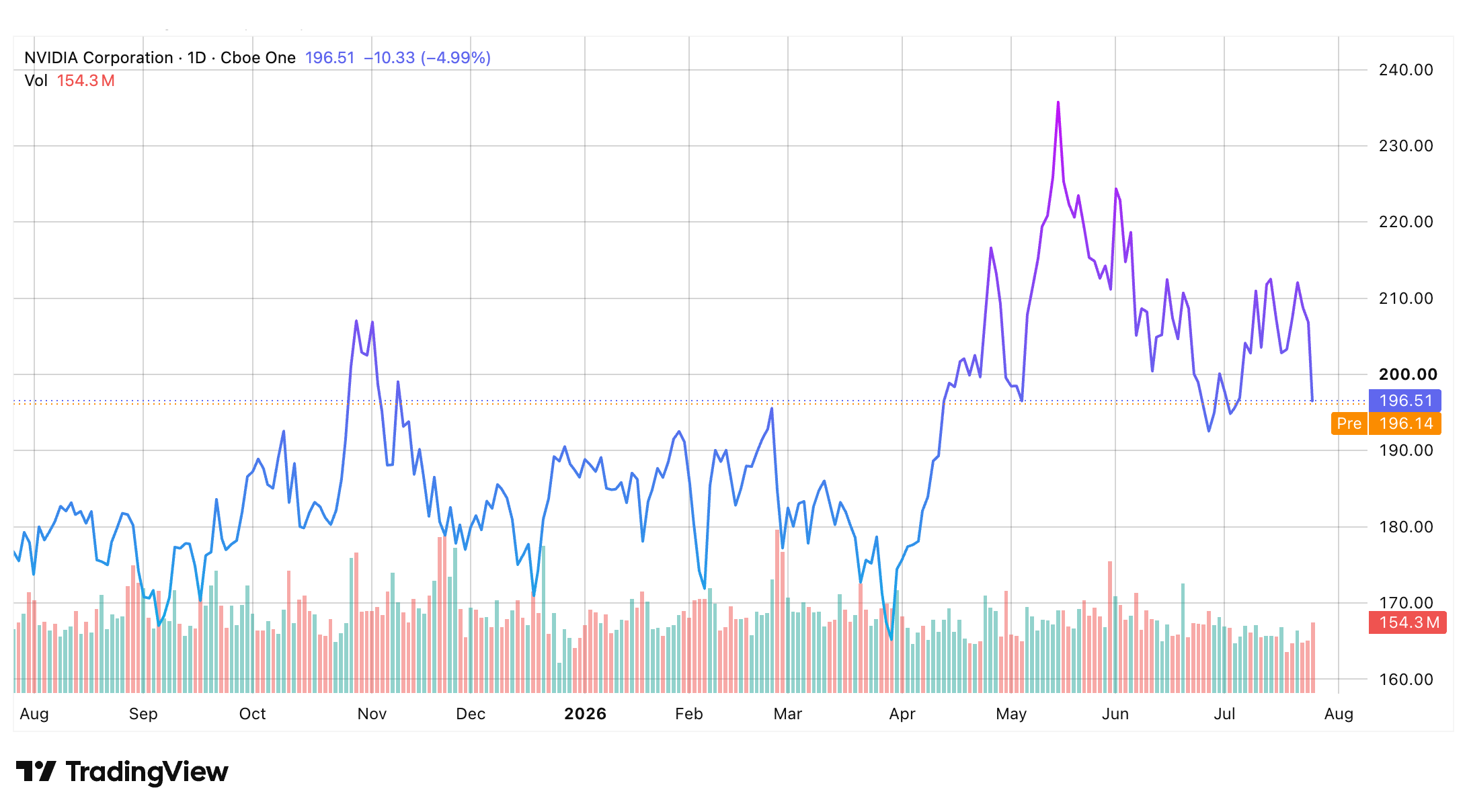
Your NVIDIA (NASDAQ: NVDA) position is down about 1.2% before the open. The question isn’t whether that hurts. It’s whether this sell-off is forced or fundamental. And those two things have very different answers for how you manage your position.
What’s Actually Driving the Sell-Off
It’s not one thing. It’s three — and they’re compounding.
First, SK Hynix’s overnight crash in Seoul triggered a global risk-off move in chips. The driver: broker reports flagging a potential memory price peak in 2027. Samsung and SK Hynix both fell more than 13% in a single session. That’s a shock big enough to move U.S. chip names on sentiment alone, regardless of fundamentals.
Second, leverage is amplifying everything. The SOX Index entered bear market territory — down more than 20% from its June record high. When an index falls that fast, margin calls kick in. Leveraged funds don’t sell because they’ve changed their view. They sell because they have to. And that forced selling can push prices well below where fundamentals would land them.
Third — and this one’s real — the Alphabet capex debate from last week hasn’t gone away:
- GOOGL spent $44.9B in a single quarter and produced negative free cash flow
- The market is asking whether AI capex returns justify the scale
- That question is now priced into every chip stock until someone answers it
The answer comes in two steps: Microsoft tomorrow July 29, then NVDA on August 26.
The Bear Case — and Why It Has Weight
Don’t dismiss the bear case just because some of the selling is forced. There’s a real argument underneath it.
AI capital spending has gone parabolic. Microsoft, Google, Amazon, and Meta are all guiding for hundreds of billions in data center investment in 2026. That’s good for NVDA in the short term — demand for H100 and Blackwell chips is real. But the question is what happens when hyperscalers get their return on investment data and it disappoints. That’s when capex moderates. And when capex moderates, NVDA’s revenue growth decelerates sharply.
There’s also the China angle. Export restrictions have permanently closed NVDA’s largest potential market. Revenue from China has collapsed. The company is trying to fill that gap with new customers — but at smaller order sizes and lower margins.
And the valuation isn’t crazy cheap. At roughly 22x forward earnings, NVDA is near a decade low for the stock. But “near a decade low” on a company that’s grown EPS 212% in nine quarters still requires the growth to continue. If it doesn’t, 22x isn’t cheap enough.
The Bull Case — and Why It’s Still Standing
But here’s what the bear case can’t easily explain. NVDA’s Q1 FY2027 EPS came in at $1.87 — beating the $1.77 estimate. Revenue guidance for Q2 FY2027 is $45 billion, up roughly 10% from Q1. The Blackwell ramp is ahead of schedule by management’s own account. And the order backlog from hyperscalers remains multi-quarter visible.
The sell-off over the past few weeks has erased roughly $2.1 trillion in semiconductor market cap. But JPMorgan looked at this same drawdown last week and said the gap between stock prices and earnings estimates is growing — which means valuations are actually getting cheaper as fundamentals hold.
And retail isn’t flinching. NVDA sentiment on major forums scored 62 — bullish — over the weekend. AMD scored 82 on its own communities. That’s not a crowd abandoning the thesis. That’s a crowd holding through forced liquidation.
Microsoft’s Azure capex commentary tomorrow tells you whether the hyperscaler demand signal is real or softening. That’s the data point this entire debate is waiting for.
Where Your NVDA Position Actually Stands
Forced selling ends. Fundamental shifts don’t. And right now, this looks more like forced selling amplifying a real-but-manageable debate than a fundamental breakdown.
For Band 1 holders who built NVDA before 2024 — you’re sitting on gains even after this drawdown. The August 26 print resolves the demand question with actual numbers. That’s 29 days away.
For Band 2 holders sizing a position today: Microsoft tomorrow is your first signal. If Azure cloud growth accelerates and capex guidance holds, the thesis is intact. If Microsoft pulls back on spending, recalibrate.
Forced selling creates windows. But only if the fundamentals come through.
What to Watch
Microsoft (NASDAQ: MSFT) reports tomorrow July 29 after the close — Azure cloud growth rate and FY2027 capex guidance are the numbers that move NVDA.
If Microsoft’s cloud accelerates and capex holds or rises, that’s a direct demand signal for Nvidia chips. Meta (NASDAQ: META) and Amazon (NASDAQ: AMZN) follow later this week with similar capex reads.
And the FOMC decision lands today — a hold is fully priced in, but Warsh’s tone on inflation and rates matters for every growth multiple in your portfolio.