Microsoft Up 7%. Meta Fell. Same AI Bet. Different Bills.
Azure hit 43% growth and crossed $100B annual revenue — MSFT popped 7% after hours. Meta's EPS missed by 15% and raised capex again. Your positions in both just moved.

Key Points
Microsoft Q4 revenue hit $90B, up 18%; Azure grew 43%, crossing $100B in annual revenue for the first time.MSFT surged 7-8% after hours; EPS of $4.81 beat estimates by 13%, with Q1 FY27 Azure guidance of 45%.Meta’s EPS came in at $6.18 versus the $7.18 estimate; capex guidance rose to $130-145B and operating margin fell to 31%.
Microsoft went up 7%. Meta went down. Both reported last night. Both made the same AI infrastructure bet. But only one of them showed the market that the bet is paying off.
Azure grew 43% — faster than Q3’s 40%. Revenue hit $90 billion. EPS came in at $4.81 against a $4.24 estimate. And Q1 FY2027 guidance came in at 45% Azure growth — above every estimate on the street.
Meta’s numbers told a different story. Revenue grew 28%. But EPS fell to $6.18 from $7.14 a year ago. Operating margin collapsed from 43% to 31%. And capex guidance went up again — to $130-145 billion for the full year.
What Microsoft Actually Delivered
This wasn’t a soft beat. Azure reaccelerated to 43% constant currency growth from 40% last quarter — beating the 40-40.2% consensus. Revenue of $90 billion cleared the $87.62B estimate by $2.4B and grew 18% year over year. EPS of $4.81 beat the $4.24 estimate by 13%.
The numbers that matter most for your MSFT position:
- Azure annual revenue crossed $100 billion for the first time — a threshold that changes the narrative on monetization
- Commercial remaining performance obligations jumped 84% to $678 billion — multi-year revenue visibility at scale
- Copilot exceeded 30 million paid seats — AI services now accounting for roughly 16 percentage points of Azure growth
- Q1 FY2027 Azure guidance: 45% — beating StreetAccount’s 41.4% consensus
- Operating cash flow for Q4: $55.4 billion; full-year: $182.9 billion
One caveat worth keeping. Part of the EPS beat came from a one-time investment gain, not core operations. And quarterly capex of $41 billion jumped 69% year over year. The stock popped on the guidance and the Azure acceleration — not on cheap spending.
Why Meta Fell on a Revenue Beat
Meta’s revenue grew 28% to $60.80 billion — beating estimates. Ad impressions rose 14%. Average price per ad rose 12%. By almost any top-line measure, Meta’s advertising engine is still running strong. And the stock fell anyway.
Two things broke the story. First, EPS dropped to $6.18 from $7.14 a year ago — a 13% decline, against an estimate of $7.18. That’s not a soft miss. Operating margin fell from 43% to 31% as capex consumed what the ad engine generated. Second, management raised the lower end of full-year 2026 capex guidance to $130 billion — the third raise in three quarters.
A beat alone won’t move META higher. That’s been true all year. The pattern is now established: strong top line, rising capex, compressing margins, stock sells off. And the market’s still waiting for the AI infrastructure spend to show up as durable margin recovery.
For your META position in Band 1 or 2: the ad engine isn’t broken. But the spending bill keeps growing while EPS declines.
What the Contrast Tells You
Microsoft and Meta are spending on the same thing. The market rewarded one and punished the other. And the difference is specific.
Microsoft’s Azure acceleration shows that the spend is generating revenue at a faster rate than the spending itself is rising. A $678 billion commercial backlog growing 84% in a single quarter means clients are committing to future spending at a pace that outstrips even Microsoft’s own buildout. That’s the virtuous loop the market was waiting to see.
Meta’s capex is rising faster than its margins can absorb it. Revenue is growing, but EPS is shrinking. The AI infrastructure build hasn’t yet shown up as durable profit growth — and management can’t give investors a credible timeline for when it will.
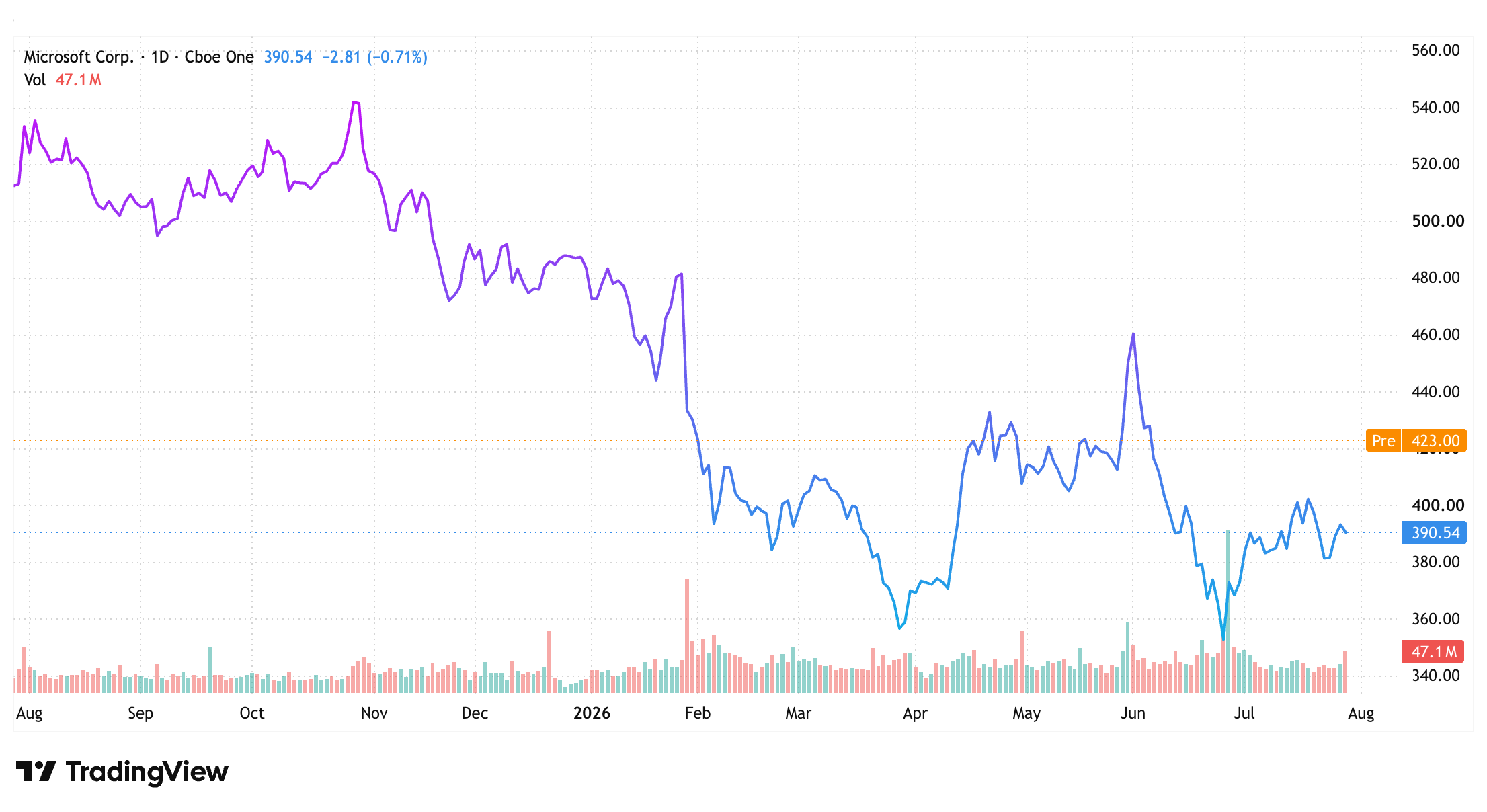
But here’s the real-world implication for your portfolio. MSFT’s 7% pop leaves the stock at roughly $418 — still 25% below its $555 record. And META’s selloff continues a pattern that’s now been true for three consecutive earnings calls. Neither situation is resolved. One is improving. One isn’t yet.
Where Your Positions Land Today
MSFT’s Azure reacceleration to 43% — and Q1 guidance of 45% — is the data point that breaks the “capex without returns” narrative for Microsoft. Not completely. But meaningfully.
For Band 1 and 2 holders who’ve owned MSFT through the drawdown from $555: last night’s print validates the thesis. The 25% gap to the record is now a valuation question, not a fundamental one.
For META holders: the ad engine is real. But EPS declining while capex rises is a trend that needs to reverse before the stock rebuilds trust. Amazon and Apple report tonight — watch AWS growth for the next read on whether cloud monetization is broad or Microsoft-specific.
Where Your Positions Land Today
MSFT’s Azure reacceleration to 43% — with Q1 guidance at 45% — breaks the “capex without returns” narrative for Microsoft. Not completely. But meaningfully.
For Band 1 and 2 holders who’ve owned MSFT through the drawdown from $555: last night validates the thesis. The 25% gap to the record is now a valuation question.
For META: the ad engine is real. But EPS declining while capex rises is a trend that needs to reverse. Amazon and Apple report tonight — AWS growth tells you whether this is a Microsoft story or a sector story.
What to Watch
Amazon (NASDAQ: AMZN) and Apple (NASDAQ: AAPL) both report tonight July 30 after the close. Amazon Web Services growth rate is the single most important data point — if AWS accelerates alongside Azure's 43%, the capex-without-returns narrative shifts from sector-wide to Meta-specific.
Apple's on-device AI strategy and iPhone demand guidance matter for your AAPL position but don't carry the same capex read-through.
NVDA reports August 26 — but tonight's AWS number is the next meaningful proxy for whether Blackwell chip demand is real.