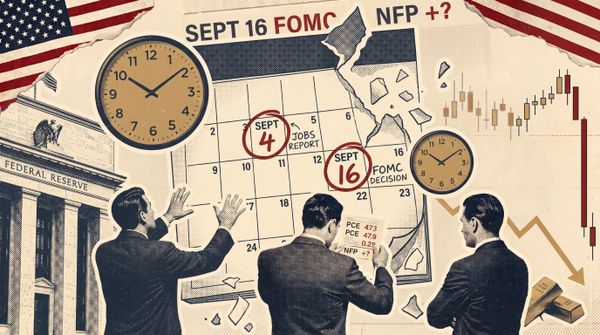
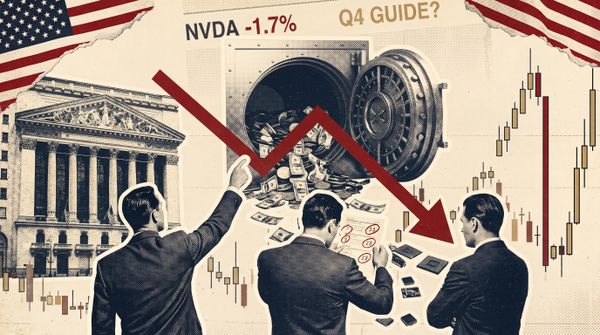
NVDA Wednesday. Warsh Friday. Your Portfolio Has Two Days That Matter
Two events this week that move different parts of your portfolio in different directions. NVIDIA's earnings print Wednesday resolves the AI chip cycle question

Key Points
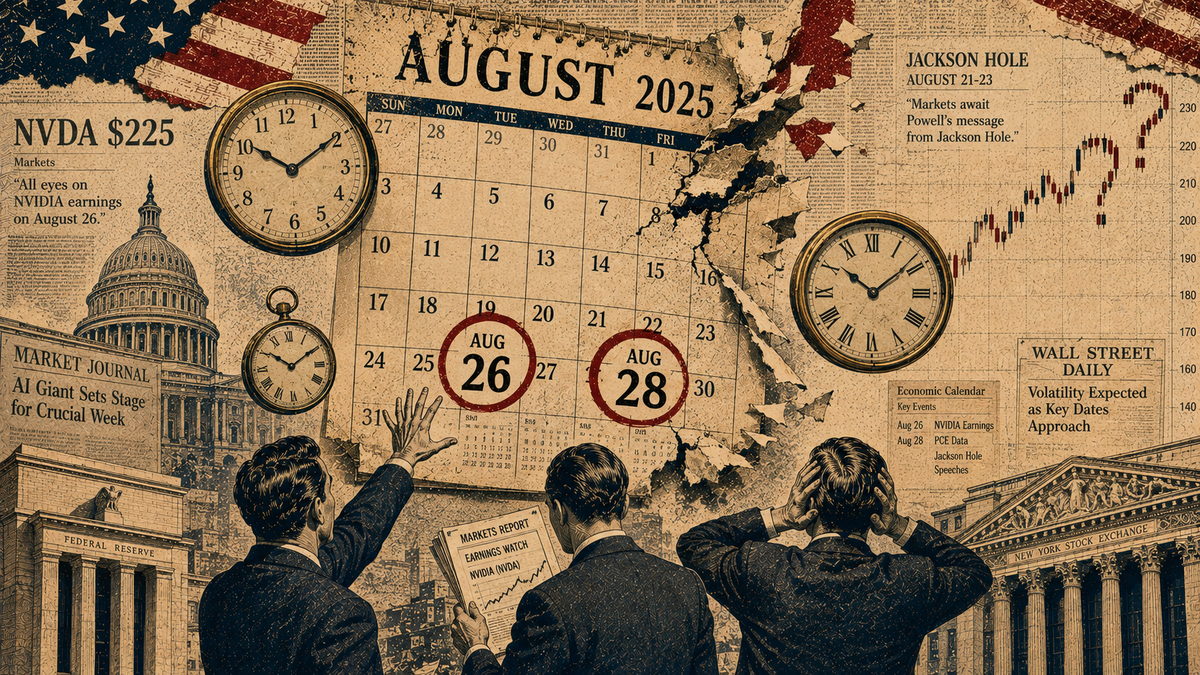
NVIDIA reports Q2 FY27 results after the close Wednesday August 26; Q3 guidance vs. the $103.1B consensus is the number that moves the stock.Fed Chair Warsh delivers his first-ever Jackson Hole keynote Friday August 28 at 10:00 AM ET — just 19 days before the September FOMC meeting.September rate hike odds sit at roughly 1-in-3, the 30-year Treasury yield is at 5.27%, and inflation remains at 3.4% against a 2% target.
NVDA is at $225. It reports Wednesday after the close. And the question isn’t whether it beats — it’s whether the Q3 guide comes in at or above $103 billion.
Two days later, Warsh walks to the podium at Jackson Hole for the first time as Fed Chair. Inflation’s at 3.4%. Three members of the FOMC voted to hike at the July meeting. September’s rate decision is 19 days away.
Your growth positions care about Wednesday. Your income positions, bond allocations, and dividend payers care about Friday. Both events land this week.
NVDA Wednesday — the Setup You Already Know
Two numbers. Nothing else matters this week for your semiconductor positions.
NVDA reports after the close Wednesday August 26. Stock closed at $225.16 Friday — roughly flat since it reported Q1 FY27 in May, down slightly from the $232 high it reached afterward. The setup:
- Q2 FY27 revenue consensus: $91.85 billion — NVDA’s own guide is $91B, so the bar’s barely above management’s midpoint
- Q3 FY27 consensus: $103.1 billion — this is the number that actually moves the stock
- A Q2 beat in the 4–5% range (consistent with recent quarters) lands near $95–96B. Expected. Doesn’t move the stock.
- A Q3 guide at or above $103B means the AI buildout has runway into 2027 — your NVDA, SMH, and QQQ positions hold their valuation
- A Q3 guide below $100B is the first visible inflection in the AI chip cycle — and reprices every semiconductor name in your portfolio, not just NVDA
Hyperscalers are expected to nearly double capex in 2026, and capex is forecast to exceed $1 trillion in 2027. That’s the demand signal supporting NVDA’s Q3 guide. But the guide itself is what the market needs to see in print.
Warsh Friday — the Unknown That Moves Everything Else
Warsh speaks at 10:00 AM ET Friday August 28. It’s his first Jackson Hole keynote as Fed Chair. And the market doesn’t know what it’s going to hear.
That’s not typical. Most Jackson Hole speeches are well-telegraphed before they happen. Warsh himself said at the July 29 press conference that his August speech was “a blank sheet of paper.” He hasn’t committed to hawkish or dovish framing. And 69% of fund managers surveyed by Bank of America expect a neutral tone — neither hawkish nor dovish.
But neutral is already priced in. Which is the problem —
The July FOMC meeting saw three regional bank presidents dissent in favor of a rate hike — the first three-way dissent since 2016. The 30-year Treasury yield is at 5.27%, near a two-decade high. The U.S. dollar has dropped to its lowest level since May. Warsh arrives at a moment where the bond market is already doing some of the Fed’s work for it — but that doesn’t mean he’ll say so.
For your income positions, REITs, dividend payers, and any bond allocation: Friday’s speech is the rate signal that determines whether those positions get tailwinds or more pressure going into Q4.
What the Two Events Tell You Together
NVDA Wednesday and Warsh Friday don’t look connected. They are.
If NVDA guides Q3 above $103 billion, it confirms that the AI infrastructure cycle is still accelerating. That’s a direct argument against rate hikes — it means the capex bet is paying off, productivity is rising, and the disinflationary case Warsh himself has made in the past gets data support. A strong NVDA print, in this specific macro context, actually supports a more dovish Friday from Warsh.
And the reverse. If NVDA’s Q3 guide disappoints — say $98-100B — it signals that the hyperscaler capex cycle is plateauing. That removes the disinflationary argument. It leaves Warsh with sticky inflation at 3.4%, three dissenters behind him, and nothing from the technology sector to suggest the inflation problem is self-resolving.
That combination — weak NVDA, hawkish Warsh — is the scenario your portfolio needs to be prepared for. Not predicted. Prepared for.
For Band 1 holders with concentrated AI exposure and Band 3 holders with rate-sensitive income positions: this is the week where those two exposures get clarity.
What to Watch — and When
Wednesday is your AI print. Friday is your rate print.
For your NVDA, SMH, or QQQ positions: Q3 guide at or above $103B by Wednesday evening is the validation. Below $100B is the inflection. The revenue beat on Q2 is context, not the catalyst.
For your income positions, dividend stocks, and any bond exposure: Warsh’s Friday speech at 10:00 AM ET is your rate signal for the next 90 days. Neutral keeps the current picture intact. Hawkish surprises the market. Dovish is the scenario the fewest people are positioned for — and would move bonds sharply.
Both pieces of information are available by Friday afternoon.
What to Watch This Week
NVDA — Watch Q3 FY27 revenue guidance vs. the $103.1B consensus at Wednesday evening’s call. A guide at $103B or above validates the AI chip demand cycle and gives your semiconductor positions a cleaner setup. A guide below $100B is the first credible inflection signal in the cycle and reprices the entire semiconductor sector.
MRVL — Marvell Technology (NASDAQ: MRVL) reports Thursday August 27 after the close, up 180% year-to-date against NVDA’s 17%. Consensus: EPS $0.93, revenue $2.71B, both +34-38% year over year. MRVL is the custom chip play — a strong print here confirms that chip demand is broadening beyond NVDA’s Blackwell platform.
What to Watch
Wednesday August 26: NVDA reports after the close — Q3 guide vs. $103.1B is the only number that matters.
Also Wednesday morning: GDP Q2 second estimate at 8:30 AM ET and PCE inflation data. If July PCE comes in above 2.5%, it reinforces Warsh's difficult position heading into Friday.
Friday August 28, 10:00 AM ET: Warsh delivers his first Jackson Hole keynote.
Key risk: three FOMC dissenters plus 3.4% inflation means the risk of a hawkish surprise is real — and underpriced by markets expecting neutral.